Sunday, 22 June 2025

Robert Siodmak and the proto-giallo?

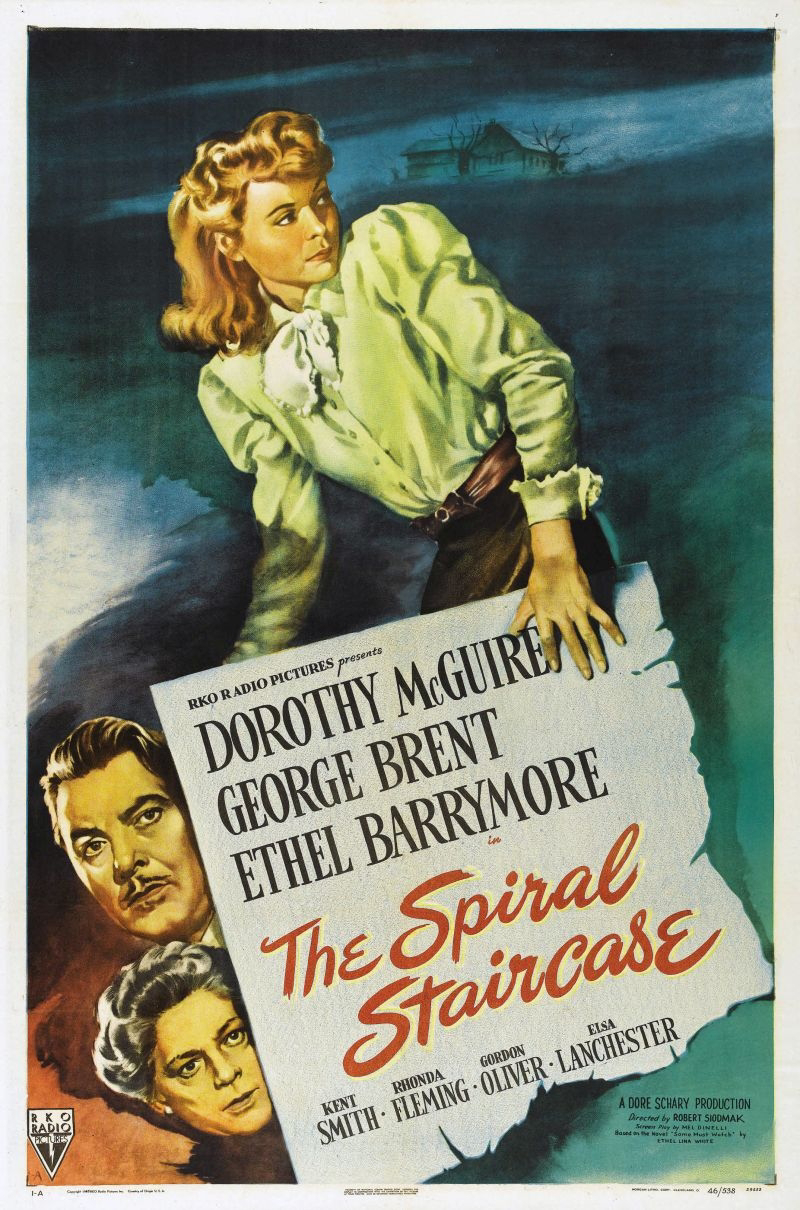
So, last night I re-watched Robert Siodmak's The Spiral Staircase—a stunning, gothic, Lewton-esque thriller with expressionistic undertones. I was struck by the number of ideas, here, that would later emerge in gialli—most obviously, how the identity of the killer is obscured using a fedora–raincoat–black gloves motif. Then there’s the red herrings and the use of the "Lewton Bus". And, lastly, the eyes in darkness—a device I think Argento would go on to use from time to time. Even geometry—the staircase itself—is something that finds echoes in giallo filone.

So, my question: are there any notable, earlier, examples of a similar fedora–gloves–raincoat device—particularly in a similar murder-mystery? Maybe in the context of an Edgar Wallace adaptation?

I believe Hitchcock's The Lodger features a similar motif, but not in a way that feels as giallo-esque as it does in The Spiral Staircase. Basically, what earlier titles could also be said to provide a template for the giallo filone?

Saturday, 24 May 2025

Perverse Countess, The (Jess Franco, 1974)

Silvia is naked—and running for her life. In pursuit: Countess Zaroffstriking, Amazonian, armed with bow and arrow. And—also naked. In the undergrowth, the Count—played by Howard Vernon—is watching!
Even before Silvia was being chased down for sport, things were starting to unravel. But how, exactly, did Silvia find herself in this predicament?

Well, since The Perverse Countess is a Jess Franco film, any attempt to explain this via synopsis would probably be a mug’s game—because this cautionary fairytale—Franco’s riff on The Most Dangerous Game—operates through subtext, foreshadowing, and power dynamics, often expressed through the unspoken: through gestures, through cutaways, through framing.

But, long story short, things went pear-shaped because Silvia was just too damn soft. Joining a lineage that, by the early ’70s, had already included Romina Power in Justine, Marie Liljedahl in Eugenie… The Story of Her Journey into Perversion, and, later, Susan Hemingway in Love Letters of a Portuguese Nun, she was just the latest in a line of doe-eyed naïfs that Franco would put through the Sadean wringer. Because Silvia—played, uncredited, by 19-year-old Lina Romay—finds herself drawn into a world of betrayal and cruelty, where sex isn’t about intimacy, but about control.

Here, fucking becomes violence: the body an instrument of power. The orgasm is used to dominate, restrain, break resistance, and demand obedience—all under a cold, detached, fetishistic gaze.

There are two such scenes in The Perverse Countess—both ménage à trois, both involving Silvia. Each is meticulously staged, framed, and choreographed—each serves to express key themes through eroticism.

Initiated by Silvia’s so-called friends: Tom, played by Robert Woods, and Moira, played by Tania Busselier—the first represents a betrayal of trust. Nothing about the encounter with this malevolent, mercenary couple, feels especially consensual! Yet, as Silvia, already plied with alcohol, finds herself pushed into a bedroom—towards a waiting Moira—she offers no resistance. As Moira’s caresses find their spot, Silvia immediately succcumbs—crumbling under breaking waves of intense pleasure.

However, this is not really presented, purely, as a seduction. Instead, it is staged as a form of degradation—and for the amusement of the onlooker! Indeed, throughout the film, the very act of gazing—the subjugation-and-voyeur dynamic—becomes a form of ritualised sadism. And this is a theme, to which, the director returns—time and again. Here, Tom embodies that particular motif: the voyeur as Master of Ceremonies. Captured in low angles, with wide lens and deep focus, he stands upon the balcony—drinking in the moment, savouring his power. Until, eventually, with patience spent, he violently casts Moira aside—he claims his property. Silvia is to be his—and he will take her!

Later, at the hands of Count and Countess Zaroff, sex takes on a slightly different symbolic role. It becomes an expression of naked class power—this time with Alice Arno’s Countess recycling Tom’s dom role. Meanwhile, the Count cuts a somewhat pathetic figure—as he lurks in the shadows.

With this encounter, Silvia relinquishes yet more of her self. And, by the time she is cut loose—for a Richard Connell–inspired denouement—it becomes clear that this nothing but an elaborate process of conditioning. The result? Well—

Put simply, Silvia is no longer a person—Silvia is now prey!

Monday, 5 May 2025

Don't Torture a Duckling (Lucio Fulci, 1972)

A car passes. Then a second. And a third. In slow motion, our eyes are drawn to the occupants. In the passenger seat—nursing a beach ball—a disengaged child stares ahead wordlessly. As non-diegetic children's laughter mingles with Riz Ortolani's exquisite strings, the car slips from the frame. Nearby, Maciara—concealed by a ridge. She is all crumpled and broken. Maciara is dying!
Played with pitch perfection by Florinda Bolkan, Maciara had, moments earlier, been released from police custody. For, while it was indeed true that she'd confessed to infanticide, her ramblings—of spells and pins stuck in wax dolls—were deemed too superstitious, too unconvincing, to hold up. So—free she was. But, alas, for her, this would be a liberation short-lived.

Maciara stumbles into the harsh sunlight. As she makes her way down the narrow lane, a woman is seated nearby. Knitting needles clicking, she spits onto the cobblestones in disgust. Another does the same. As Maciara passes a window, it is slammed shut.

Eventually, she reaches the cemetery. There are men here—vigilantes. They mean her harm. The first, standing beside his car, fidgeting with the antenna. A radio crackled to life as he reaches inside. From the shadows, a second appears—wielding a lump of wood. Maciara senses threat. She reaches for the gate. Too late. Slam! Fingers break—she screams.

The camera lingers. One assailant picks at his teeth—unmoved. A third approaches. They close in.

What follows is a moment of baroque horror—among Italian cinema’s most visceral. Shot in low angles and extreme close-ups, it unfolds with savage excess.

The men leave—their violence spent. Maciara is left beaten and bloodied, beginning her long crawl for safety—a torturous Via Dolorosa, echoing Fellini’s Il bidone. It's a seemingly futile search for salvation.

If. She. Can. Just. Get. To. The. Road...

That this heartbreaking scene should culminate at the Autostrada feels grimly appropriate, for the symbolism of this road is integral to Lucio Fulci's tale—right from the opening frame. He draws our attention to the same bridge—repeatedly. It even comes with its own, disquieting, wailing leitmotif!

Even as Maciara's character comes into focus for the first time, it is in the context of a wide, panning, establishing shot of a serpentine flyover. And, as she claws at the soil with her bare hands, it is on a hillside overlooking the stretch of tarmac cutting across the valley floor.

Sure, Don't Torture a Duckling delivers all the classic giallo elements—including the occasional red herring. But Fulci, it seems, has a bigger fish to fry—he’s putting a particular provincial mindset on trial. And this is summed up perfectly in one, particular, line of dialogue:

“We can build highways, but we can’t overcome ignorance and superstition.”

Saturday, 19 April 2025

Cool It Carol! (Pete Walker, 1970)

Cool It Carol! was oft regarded as part of the decade-long wave of comedies featuring the likes of Eskimo Nell, Au Pair Girls, Come Play With Me, and the Confessions series. This association was underscored by an early star turn from British cinema's saucy seventies mainstay and perennial cheeky chappie, Robin Askwith. However, the film, while nominally a comedy, played more like a kitchen sink drama—with tits.
Indeed, were one to have taken Janet Munro’s Jennie Jones from Peter Graham Scott’s Bitter Harvest, paired her with Tom Courtenay from John Schlesinger’s Billy Liar, then set them loose upon London, à la Smashing Time, the result may have been something akin to this third foray into sexploitation cinema from Pete Walker.

Robin Askwith portrayed Joe Sickles—a young, bored, small-town butcher’s boy with dreams of a better life. Hoping to impress, he regaled seventeen-year-old petrol pump attendant and former beauty contest winner Carol—played by Janet Lynn in her sole starring role—with tales of celebrity friendships and lucrative job offers in high-end, London car showrooms. Fueled by self-belief and aware of the opportunities for an aspiring model, Carol persuaded a reluctant Joe to join her in a move to the capital—seducing him en route. This significant encounter served to suggest a matter-of-fact approach to sex and the actions of a fully grounded, self-assured young woman, guiding a naïve, if somewhat hubristic, companion.

However, no sooner had the couple arrived at the capital, than the dynanamic of this relationship seemed to shift—the mood darkened. For, what initially played out in breezy sex-comedy territory—with montage, and nod to swinging London counterculture—quickly turned sour, as mishaps and missteps befell our babes in the wood.

As money dwindled, and so too the job opportunities, an unemployed Joe pressured Carol into sex work—effectively pimping her on the street. Fashion shoots gave way to glamour sessions, and ultimately to 8mm Soho stag loops—shot on hand-cranked Bolex. While, throughout, Carol was watched by an ever-present fringe of lip-licking, raincoated, predatory older men, loitering at the edges of the frame.

Viewed through an almost documentarian lens, Carol’s descent reached its nadir in a brilliantly handled, yet extremely harrowing, extended scene, in which she was forced to endure a procession of men soliciting sex—even while, beyond the curtain, boyfriend Joe paced to the discomforting diegetic beat of grunts and the rhythmic clatter of the kettle.

This sequence left a lingering sense of unease, which did not dissipate—even as the road ahead glimmered with the bountiful wages of perseverance—as Carol, betwixt pimp and pornographer, and inundated with photoshoots and upmarket Johns, became drawn into an increasingly lucrative, yet amoral, world. At this point a tonal shift, and an accompanying attempt to restore breathless levity, failed to land. As a result, Cool It Carol! ultimately felt more a grim cautionary tale than comedy.

Thursday, 10 April 2025

Eurocult: When it clicks, it clicks!

I love Eurocult. I especially love Italian movies of the sixties and seventies. I can say that now—with some confidence. But, there was once a time when that wasn't the case. I just didn't get them at all!
I was just entering my teenage years when my parents announced that the family were getting a VHS video recorder. This was the early 80s, Britain's pre-cert era, and the height of the Video Nasties scare. Like a lot of my friends at the time, I was a fan of all things horror. I loved the pulp horror novels that you could pick up at Woolies, Smiths, or the Central Bus Station kiosk, and I loved horror movies.

However, since the village only had a small video library, I found myself borrowing the same handful of Italian horror films over and over. But, while I was drawn to the gore, I’ll admit that I found the films, themselves, a bit strange. They were hypnotic, for sure, but they were very different from the more familiar Universal Monsters of the BBC Horror Double Bill. Indeed, those early encounters with Italian horror left me feeling unmoored and adrift—the experience not unlike that disengaged, dream-like state between wakefulness and sleep—waiting to be jolted, occasionally, by moments of Théâtre du Grand-Guignol, Italian style. First, the calm, then—bam! The storm! An eyeball skewered!

Of all the directors, I especially loved Lucio Fulci's predilection for cinematic excess. However, I definitely felt there was something a little off-kilter about his films. There was something that I couldn’t quite put my finger on. What it was exactly? Could it, maybe, have been the exposure to an unfamiliar and deliberate pacing? Possibly, yes—to an extent. But, with hindsight, there was something else that baked my noodle. It was that dubbing!

My very first exposure to voice dubbing and post-synchronized sound in Italian genre cinema came, coincidentally, with my very first VHS rental—Zombie Flesh Eaters. And I suspect the actual moment I became truly aware that something was askew was when yacht skipper Brian Hull, played by Al Cliver, delivered his first line. Because even though the voice was striking—and distinct—it was clearly not his own. That voice, I would later discover, belonged to prolific English-born voice actor and dubbing supervisor Nick Alexander. And the disconnect bugged me. Still, at the time, there were far more important things to worry about than Al Cliver's voice. And so, with exams approaching, my first dalliances with Eurohorror had drawn to a close.

Years passed. I started shaving, failed exams, left school, had a go at driving, didn't get it, gave up, got a job and a girlfriend, lost both, got burgled, started over, got engaged—and then, on a whim, found myself wanting to revisit the films of my youth. Now, in my late twenties, with the millennium fast approaching, and, possibly out of nostalgia, I secured a copy of Dario Argento's Tenebrae—to watch—for the first time in years.

You know what? It’s funny how the passage of time can alter one’s perceptions. Because, this time, when it came to Italian horror and thrillers, everything just felt right.

This experience led me to seek out more titles. Zombie films. Horror films—The Living Dead at Manchester Morgue, Zombie Creeping Flesh, Nightmare City, The Beyond, Anthropophagus. Then House by the Cemetery. I got into giallo, and then, ultimately, poliziotteschi. I was on a roll! Discovering Franco. Rollin. Borowczyk. My journey into Eurocult had begun.

And from there I segued—surprisingly—into the French and Czech New Wave: from Truffaut, to Godard, to Rohmer and Varda. To Věra Chytilová. To Murnau and Dreyer. And, of course, brilliant Bergman.

With that journey came a realisation—that voice actors are something vital to the distinct nature of the Italian filone. A dubber does not simply read lines—they give a character an identity. When I watched Barbara Magnolfi speak of sssnakes in Suspiria, I knew it was the voice of Carolyn De Fonseca, who also dubbed Daria Nicolodi’s Gianna Brezzi in Deep Red, Corinne Cléry in Lucio Fulci’s The Devil’s Honey, and was the voice of Lara Wendel in The Red Monks. She had been the voice of all these. But still, in that one moment, it just worked—character, actress, voice—all one! Olga!

Saturday, 5 April 2025

Giallo is not a genre!

Giallo is not a genre. There! I said it! I thought that point was widely accepted, but it turns out I was wrong. Indeed, just the other day, I came across yet another reference to the "giallo genre" and witnessed people arguing over whether this, or that, film fits the latest gatekeeping standards. And if it doesn’t? Well then, apparently, it must be exorcised from the giallo canon because them's the rules. But, you know what? I’m not having it!
I'm sure we've all seen comments like, "I don’t think Footprints on the Moon is a giallo", or "I don’t think Orgasmo counts". It's not a view I share but I get it—I really do. After all, as a fan of cult cinema, I am aware that the line between cult and genre films is razor-thin. But, if science fiction, westerns, or horror are on one side of that genre line, then gialli are on the other—as not so much a genre but, maybe, at best, genre-adjacent.

So why, then, suggest that giallo is a genre at all? Well, as a physical media collector, that’s a very big question—perhaps one we can delve into some other time. But I’m sure I’m not the only boutique Blu-ray obsessive with a “horror” shelf. I mean, if you’re picking up releases from Severin, Mondo Macabro, or 88 Films, chances are you've got a horror section, right? Unless, of course, you organise by distro—which is fair. Or alphabetise, in which case... I’m not really sure we can be friends.

Anyhow, this leaves us with the tricky question of what to do with that growing stack of gialli that began with an Arrow sale and is now bulging with those wonderful Forgotten Gialli boxsets. (Volume 8, which is on a limited run, is selling briskly, by the way.)

So, you've got your horror shelf—but maybe, just maybe, you feel that your giallo films don’t really sit comfortably amongst all your horror titles. They are not, after all, horror films are they!? And despite being thrillers, they don’t quite belong next to Die Hard—which should be filed under “Christmas”, obviously—along with, might I add, Night Train Murders. So, what can you do?

Well, in this instance, assigning a genre classification for your giallo collection makes a kind of sense. That is up to you—your collection, your rules! But still, I have to remind you where we came in: giallo is not a genre.

But "Ah!" retort the Giallo-genrians, "not only is giallo a genre, but it has identifiable tropes and motifs that bind these films together". Then, out comes their checklist: Black-gloved killers? Check. Convoluted murder plots? Check. Dilettante sleuthing? Check. Not to mention the J&B bottles, convoluted murder plots, psychosexual themes, and unreliable witness testimony. To be fair the case they present, I concede, may well be a compelling one. Yet, still I feel this nagging doubt!

I mean, I get that, as with genre, there are motifs that so many of the gialli share. But, many is by no means all. And you won't have to look far before films confound expectations—The Possessed, for example, or Forbidden Photos of a Lady Above Suspicion. Even Footprints. All gialli, all different.

Yet, just because I don't go along with the premise of giallo-as-genre does not mean I don't see them as part of a whole. Because I do! But here’s what I’d argue: if a film like Footprints or Orgasmo can be included alongside the likes of Blood and Black Lace or Tenebrae, then maybe giallo isn’t really a genre at all. Maybe it’s something else altogether—something fluid. Something far more vital. I do have thoughts on this. Please, allow me to elaborate...

Featuring